
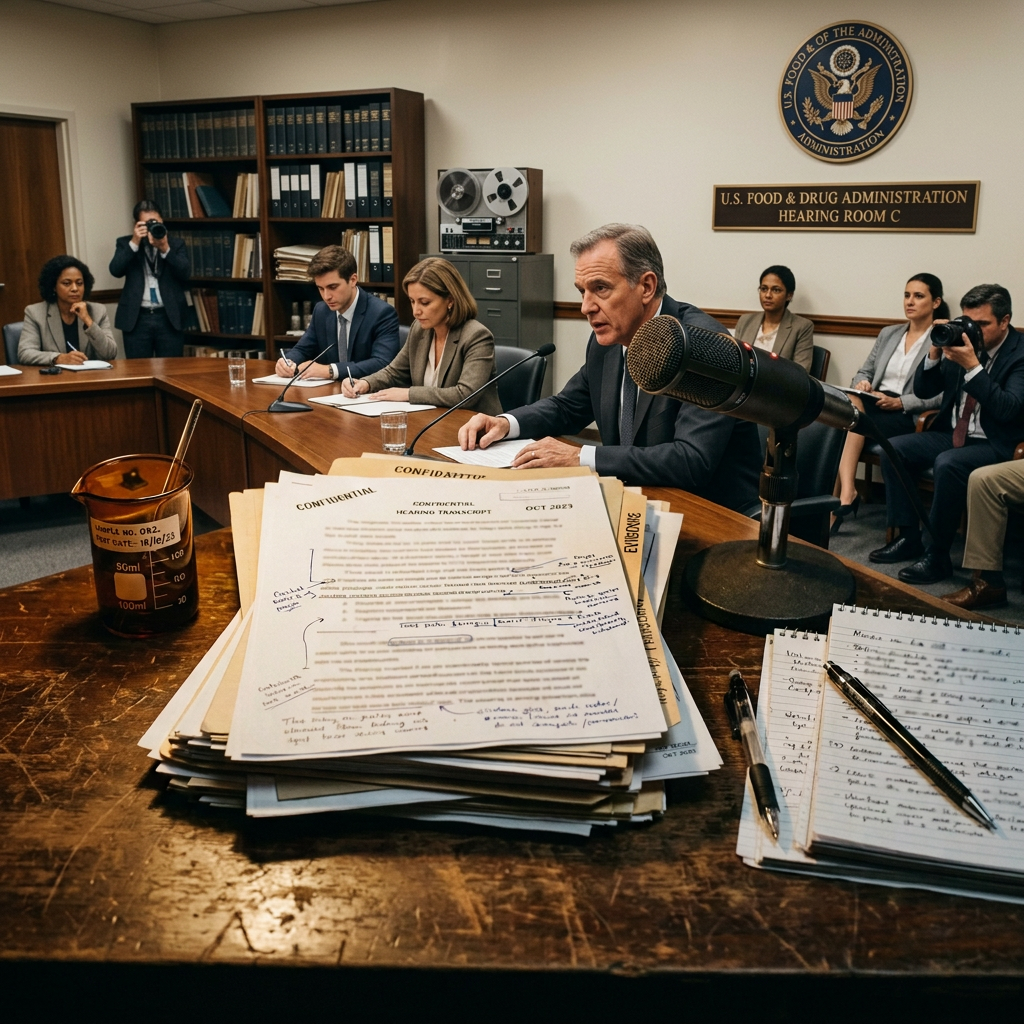
On September 14, 2026, the FDA held a public hearing on “Considerations for Potential Future Therapeutic Use of Psychedelic Drugs.” By the time the moderator called the final break, 80 speakers had taken their two minutes — some in person at FDA headquarters, others dialing in virtually — to tell the agency what they think about training, safety, access, and data. Over 200 people requested speaking slots. More than 1,800 registered to watch. And by the agency’s own count, the written docket had already accumulated significant public comment before a single microphone was turned on.
The hearing was not about approving a specific drug. It was about architecture: what kind of system should exist *around* these medicines once they start moving from clinical trials into ordinary care.
Here is what the room sounded like.
The Workforce Debate: Who Gets to Do This Work?
The first and loudest disagreement was about credentials. Dr. Rajan Dun, a psychiatrist at Harvard-affiliated Shepherd Pratt who has overseen roughly 200 participants across more than 10 trials, put it bluntly: “Psychiatrists should be at the helm.” His argument was that psychedelic care requires the full scope of psychiatric expertise; diagnostic formulation, risk assessment, and someone who can take clinical responsibility when things go sideways.
Others pushed back, gently but firmly, on the idea that one profession should own this. Heidi Allen, a professor at Columbia University, described a new psychedelic therapy training program embedded in an MSW curriculum. Her pitch: build interdisciplinary care teams rather than invent a new license layered on top of existing ones. Laura Barrett, a nurse and educator at the University of Maryland School of Pharmacy, urged the FDA to let all nurses with at least a year of experience participate, noting that “no single profession has all the competencies required for safer psychedelic care.”
Erin Atkinson, a clinical social worker who supervises more than two dozen clinicians at Prism Wellness, added a practical layer: preparation and integration are not add-ons. They are distinct clinical competencies that must be taught and assessed explicitly. “Experiential training requirements can help clinicians better understand what they are asking patients to consent to.”
The middle ground, voiced by several speakers including Lynn Marie Morski of the Psychedelic Medicine Association, was independent accreditation. Her organization plans to launch an accreditation system for training programs early next year, establishing a baseline for what curricula should cover while leaving room for different professional backgrounds.
Patient Safety: The Session Is Not the Treatment
If there was one point of near-consensus, it was that safety does not end when the acute drug effects wear off.
Lisa Ginsburg, founder of the Chang’e Institute, cited a JAMA Network Open multisite study of an Oregon psilocybin program. Across 346 patients, there were serious adverse reactions, violent episodes, emergency room visits, and new suicidal thoughts. Only one in four was caught during the actual dosing session. The other three surfaced weeks later, through follow-up.
“Session reporting caught only a quarter of the real signal,” Ginsburg said. Her conclusion: on-site supervision is a floor, not a ceiling, and safety data must be longitudinal.
Susan Tamore Seguin, from the Coalition for Psychedelic Safety and Education, put a human face on that data. She told the story of her 21-year-old daughter Shira. The details were brief — the two-minute clock was merciless — but the implication was clear: without robust screening, preparation, and follow-up, these medicines can produce outcomes no one wants.
Several speakers addressed the specific risks of ibogaine, given its association with cardiac events. One consultant for ibogaine sponsors noted that while QTc prolongation and ventricular arrhythmia are documented concerns, there is no validated prediction model yet. The ask to FDA: require common data elements and time-matched ECGs in any registry network.
Access and Equity: The Rural, the Poor, and the Veterans
The second half of the hearing shifted to access and data standardization, and the trade-offs became starker.
Shasta Wynne, an Oregon licensed psilocybin facilitator, highlighted a tension in federal posture. Oregon’s nonmedical adult supported-use model is generating real-world evidence. But the hearing expressly excluded remarks about religious, ceremonial, and personal nonmedical use. “If you want our evidence,” she seemed to say, “you cannot exclude the ecosystem that produced it.”
Derek Kozlowski, an Iraq war veteran, was even more direct. He had to leave the country to get the care he needed. Now, with therapeutic models expanding, he urged regulators not to restrict practitioners so heavily that veterans are driven back underground or abroad. “We welcome working with doctors and clinicians. But we would urge you not to put us into a situation where we have to continue working underground because it’s so restricted.”
Medicaid and affordability came up repeatedly. Liz Collins, a Colorado social worker who has spent her career with Medicaid recipients, noted that state licensing bodies are responsive to public interests and can remove dangerous practitioners — something a pharmaceutical company’s internal credentialing system cannot replicate. Her ask: require state-level facilitator licensing as part of any REMS.
On the data side, speakers warned that burdensome requirements could paradoxically reduce safety by excluding small providers, rural clinics, and community health centers from participation. Amber Barnato of the Dartmouth Institute argued that a REMS-embedded national registry could generate real-world evidence while preserving access, but only if the data collection is proportionate and aligned with state frameworks.
Data Standardization: What Should We Measure?
The hearing’s final topic was what to count, and the speakers rebelled — productively — against narrow metrics.
Dr. Svetavat, from Research Lambda, called for a “minimal data collection floor” that captures therapeutic components and safety signals without designing out the outliers who often need these medicines most. Jagpal Bennett, drawing on 24 years of ketamine experience, noted that validated symptom scales miss what patients actually care about: return to work, family reconnection, meaning, functioning.
Nikita Simmer of Fountain Health, whose clinic has administered over 1,500 IV ketamine infusions, made the point that “we should also be focused on what’s happening between treatments, not just during them.” If registries only capture the dosing session, they miss the care that surrounds it.
Several speakers emphasized compound-specific requirements. A framework appropriate for high-dose psilocybin may be irrelevant or dangerous for low-dose protocols, non-hallucinogenic molecules, or botanical products. The ask: let the pharmacology, dose, and indication drive the standards, not the other way around.
What Happens Now?
The hearing did not produce decisions. That was never the point. It produced a record.
The written comment docket, FDA-2026-N-7542, remains open until October 5, 2026, at 11:59 p.m. Eastern. The agency explicitly discouraged sending comments only to internal email addresses; the official route is Regulations.gov.
If the testimony had a through-line, it was this: psychedelic care is not a medication delivery problem. It is a systems problem. Training, safety, access, and data are not separate silos. They are interdependent, and the design of one shapes the effectiveness of the others.
The FDA heard from psychiatrists and social workers, veterans and venture capitalists, nurses and grieving mothers, researchers and facilitators who have been operating in legal gray zones for years. The diversity of the room was, in a sense, the argument: whatever framework emerges will need to be capacious enough to hold all of them, or risk pushing the most vulnerable patients back into the shadows.
What was missing from most of the testimony was the expanded access in the state regulated systems.
We would love to solicit testimony from people to be entered in to talk about the state regulated system.
Leave a Reply